I was having a chuckle about the latest “AI innovation” from China that turns out to be a “wrapper” around American tech… but still gets a ton of attention.
As one AI model after another rolls out of China and turns out to be something quite different than what people presumed it was, I’m wondering about the economic cost of the stampede.
I’m not saying the Deep Seek or other models coming out of China and other sources do not have their advantages. But are they really truly deserving of the attention they’re getting, as well as the market sure they’re capturing?
I’m also thinking about the downstream effects of people stampeding towards one technology and away from another. I don’t pretend to have insider knowledge of the markets and the overall impact of Nvidia losing all that valuation almost overnight… but I do know that the markets are very intimately connected with so many aspects of our lives. That’s often in ways that we have no idea.
What is the actual economic and social impact of mumurations of shiny object AI adoration?
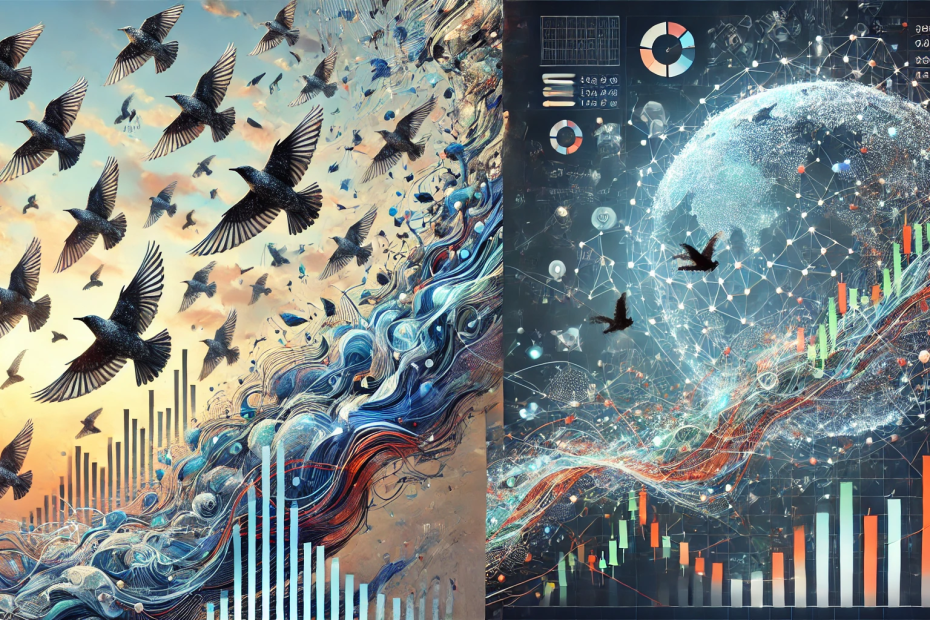
Then I got to thinking about “Murmuration Economics” as a thing. Given how quickly public sentiment can turn, and turn the markets upside-down… which can have significant impacts downstream (many of which we have no idea exist)… wouldn’t it make sense to look more closely at Murmuration economics?
I did some research on this with some models – Gemini Deep Research, which was surprisingly shallow in its appraoch, as well as my Brainstormers team in ChatGPT, which is comprised of a number of experts, including an AI-focused futurist. This will be the topic of another post and a demo, showing how my persona team actually outperformed Gemini 1.5 Deep Research. I haven’t run it through ChatGPT Deep Research. I’m saving my chits on that for bigger tasks :-)
Here’s the paper that came out of it. Download it here.
TL;DR Summary of Murmuration Economics
Murmuration in Nature
Murmuration is a mesmerizing natural phenomenon where large groups of birds (typically starlings) or fish move in highly synchronized, fluid formations without any central leadership.
- In Birds: Starlings in flight create swirling, shape-shifting patterns as each bird reacts to its closest neighbors. This behavior helps with predator avoidance, social bonding, and environmental adaptation.
- In Fish: Schools of fish move as one, responding to changes in water currents and predator threats. Their collective movement minimizes energy expenditure and increases survival chances.
Both bird and fish murmurations rely on simple local interactions (separation, alignment, cohesion), which produce emergent behavior—a complex, coordinated system arising from decentralized decision-making.
Murmuration in Economic and Social Systems (“Murmuration Economics”)
Applying the concept of murmuration to human economic and social systems reveals how collective behavior, decentralized decision-making, and emergent patterns shape financial markets, global economies, and social movements.
1. Interconnectedness of Economic Systems & Vulnerabilities
- Just like murmuration in nature, global economies function as interdependent, highly responsive systems.
- Network effects and contagion risks—akin to birds reacting to their closest neighbors—amplify disruptions (e.g., financial crises, supply chain breakdowns, pandemics).
- Predators in this system: Cyber-attacks, misinformation, geopolitical shocks, and economic warfare can destabilize entire economies, much like a predator disrupting a murmuration.
2. Collective Behavior Shaping Economic Outcomes & National Security
- Herd behavior in markets mimics murmurations: Investors, consumers, and policymakers react to information trends, sometimes irrationally (e.g., speculative bubbles, bank runs).
- Social media and algorithmic amplification act like murmuration catalysts, rapidly influencing consumer behavior, stock prices, and public sentiment.
- Manipulation & economic warfare: Disinformation campaigns can drive economic panic, affecting national security and financial stability, much like a predator steering a murmuration in a particular direction.
3. Data-Driven Understanding of Collective Impacts and Countermeasures
- Big data, AI, and network analysis can model and predict economic murmuration patterns, much like scientists study starling flight.
- Satellite data & AI-driven monitoring help track environmental, social, and economic shifts—useful for sustainability efforts but also susceptible to misuse (e.g., surveillance, behavioral manipulation).
- Ethical concerns: The ability to monitor and influence large-scale collective behavior raises questions about privacy, free will, and the potential for state or corporate control.
4. Case Studies & Applications
- Market crashes & speculative bubbles (e.g., 2008 crisis, GameStop short squeeze) illustrate how rapid, decentralized decision-making creates volatile patterns.
- Geopolitical conflicts & economic sanctions show how murmuration-like financial responses (boycotts, divestments, capital flight) can shape global power dynamics.
- AI-driven social manipulation (e.g., Cambridge Analytica, misinformation campaigns) highlights the risks of economic murmuration being weaponized to destabilize societies.
Conclusion: Potential Applications, Limitations, and Ethical Considerations
- Murmuration Economics provides a new lens for understanding economic interdependence, market dynamics, and social influence.
- Data and AI can help predict and shape these collective behaviors, but also present risks of manipulation.
- Balancing resilience and adaptability is key—both in nature and in economics—to ensure stability without suppressing organic, emergent growth.
This perspective encourages a systems-thinking approach to economics, emphasizing real-time adaptability, decentralized intelligence, and ethical considerations in collective decision-making.